
Refugio's Three-Day Release Gap
The official Refugio County Jail and Sheriff's Office sites provide no live roster, rolling 72-hour view, release archive, booking-photo list, or update cadence. A three-day query therefore cannot be performed with an official date filter. It must be framed as a request covering an exact start and end time.
The broader window can catch an event missed during a weekend, holiday, or delayed inquiry. It does not change the proof needed. A booking-out entry identifies the operational end of jail custody, while the related court order explains legal authority. Transfer paperwork shows when custody continued under TDCJ, ICE, USMS, another jail, or another agency.
Check Refugio's 72-Hour Releases
Define the period before contacting the county. Use calendar dates and times rather than “over the weekend,” then gather the full name, date of birth, booking number, cause number, and arrest date when known. A precise interval reduces same-name errors and lets the records custodian locate a booking-out event.
- Call Refugio County Jail booking information at 361-526-1698, option 1, and ask whether the person is currently held.
- If not held, ask whether the person was released to the community or transferred, and request the date, time, disposition, and destination.
- Check Texas IVSS-Counties for Refugio participation and a correctly matched event. Treat no result as inconclusive.
- Submit a narrow written request for the booking-out form, release authority, holds, and transfer documents covering the three-day interval.
- Match the sheriff entry to the court judgment, bond, dismissal, or release order.
For an event believed to have happened today, the Refugio 24-hour release guide gives the tighter same-day workflow. The source channels are the same because neither window exists online.
Refugio Three-Day Record Fields
These are fields to seek from the record owner, not fields exposed on a Refugio website. The county has not posted a release-code dictionary, and not every item is necessarily public. Ask for the minimum set that resolves identity, time, authority, and destination.
| Field | What it shows |
|---|---|
| Name, DOB, booking number | Links the answer to one person and jail stay. |
| Book-in and book-out timestamps | Places the custody span within the three-day period. |
| Release authority and code | Separates bond, personal bond, time served, order, and transfer. |
| Court or cause reference | Connects the jail exit to the controlling case record. |
| Hold or destination agency | Shows whether another authority continued custody. |
| Property receipt | May document the handling of property at exit. |
Texas Local Schedule PS sets a minimum of release or transfer plus two years for booking-out, release, and related commitment records. That minimum does not establish an online archive and does not promise disclosure of each requested field.
Refugio Weekend Release Checks
No authoritative source identified Refugio County's weekend release procedure, family waiting point, property pickup rule, or release-processing time of day. Those unknowns should stay explicit. A signed order may be entered before the person physically exits, and another hold may delay the departure after the court acts.
Build the three-day timeline with two official records. Use the court order for legal authority and the sheriff booking-out record for the actual custody end. If the dates differ, ask whether processing, a hold, or transport explains the gap. For a person whose name is known but whose custody path is unclear, the Refugio released-inmate search maps each agency system.
Note: Record both the event time and the time each portal or office was checked.
Refugio Release Source Ladder
The local route begins with the official jail booking channel, followed by a written sheriff record and the matching court file. IVSS-Counties may add timely event notice if Refugio participates, but the research could not independently confirm that participation outside the live portal. The sheriff's old VINELink link does not change the current Texas platform.
TDCJ is appropriate only after state intake or for a state prisoner or releasee. The BOP locator covers federal sentenced custody. ICE ODLS covers immigration custody and some people released from it within its stated period. A Refugio release to one of those authorities is a county transfer, not community release.
| Custody path | Correct follow-up |
|---|---|
| Refugio community release | Sheriff booking-out record plus court order |
| Refugio to TDCJ | Transfer record plus TDCJ intake detail |
| Refugio to ICE or USMS | Transfer record plus receiving agency or court |
| State prison release | TDCJ actual release record and supervision office |
Refugio Release Archive Limits
Refugio's unusual data issue is the absence of both a current public roster and a released-person archive. There is no official web lifecycle to observe. A name cannot “drop off” an official list that the county does not publish, and a copied third-party page has no documented county cadence or retention period.
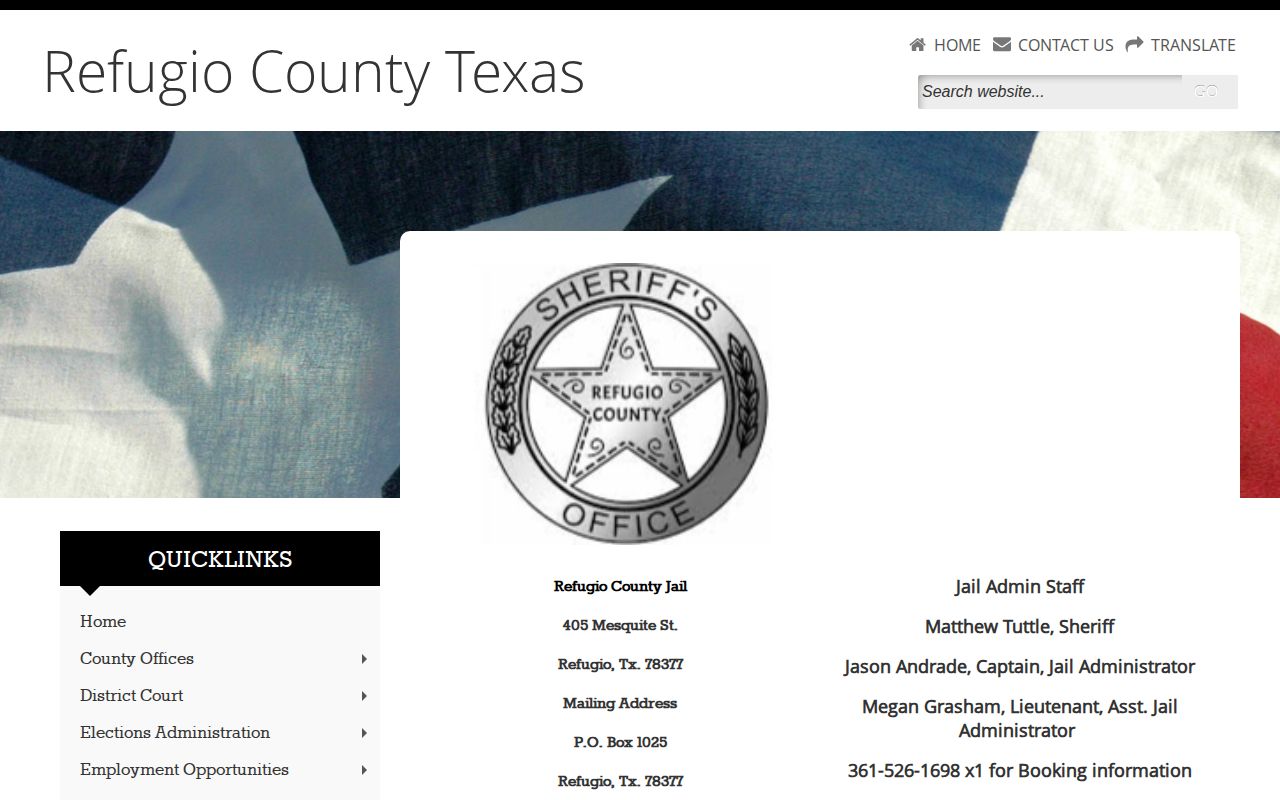
The county jail page shows contact and booking information rather than a roster. The captured official page below documents the available local route.
Keep a log of calls, requests, identifiers, and results. That record helps reconcile later changes without turning an earlier no-result into a false statement of release.
Build a Refugio Release Timeline
A three-day inquiry works best as a timeline, not a list of names. Begin with the last confirmed Refugio custody contact. Add the time a judge signed any bond or release order, the book-out timestamp, and the time a receiving agency accepted a transfer. Keep those events separate. Legal authority may exist before jail staff finish checks, resolve holds, and complete the operational exit.
When records conflict, use the source that owns each fact. A court document controls the legal decision. The sheriff's booking-out form controls the operational end of the county stay. A TDCJ intake record, ICE status, or receiving-jail entry shows that custody continued. An IVSS alert is timely navigation evidence, but its event label should not be expanded beyond the words supplied.
Compare date of birth, booking number, cause number, offense date, and agency across all three days. If those details do not line up, keep the match unconfirmed. A wider window raises the chance that two people with similar names appear in separate records.
Refugio Court Release Context
County and district records can explain an outcome long after a custody call changes. County or misdemeanor matters route through the Refugio County Clerk, while felony and district matters route through the District Clerk. A docket may show a setting, plea, judgment, sentence, bond, or later order. It normally cannot establish the moment the jail completed release processing.
Ask for the document tied to the cause number. “Bond set” does not prove bond was satisfied. “Dismissed” does not prove there was no other hold. Combining the court document with the sheriff record supplies both the legal reason and the physical custody end.
The Refugio County docket archive is useful for locating a case and reviewing events that remain visible after custody ends. It is not a jail-release database. A setting date shows court activity, while a judgment or order may explain the legal result. Neither substitutes for the booking-out timestamp when the question is whether the person left during the chosen 72-hour period.
For state custody, a TDCJ result must also be read by field. Projected Release Date, Parole Eligibility Date, Scheduled Release Date, actual release, parole start, and discharge are different events. A future date cannot be placed in a three-day list as if it already happened. Ask TDCJ for actual release history when the live detail is unclear.
Federal paths require the same care. A BOP past release date and released status concern federal prison custody. An ICE record can indicate a later immigration-custody stage. Report the sequence instead of forcing all agency events into one county release label.