
Current Refugio Notification System
Texas replaced its county VINE service with Texas IVSS-Counties on September 1, 2025. The official Refugio County Sheriff's page still points visitors toward VINELink, so the old label remains visible locally. Current county searches and account-managed notifications belong in IVSS-Counties.
The portal may cover participating county custody and case events. The Texas Attorney General describes bookings, releases, court events, death, escape, and transfers to TDCJ among the available event types. However, the research did not independently confirm Refugio as a participating county outside the live portal. Check the county selector rather than assuming coverage.
State prison and parole notifications use the separate TDCJ IVSS system. Federal sentenced custody uses the BOP locator, while immigration custody has ICE ODLS and DHS-VINE. One “VINELink” search does not cover every custody owner.
Search One Refugio County Person
A person or case search can be performed without creating an account. Gather the full legal name, date of birth, booking or case identifier, agency, and date range when lawfully available. These details matter because a name alone can produce an unsafe match.
- Open Texas IVSS-Counties and check whether Refugio County appears as an available agency or county.
- Enter the name or identifier fields the portal presents. Keep the search narrow enough to separate similar names.
- Open the matching person or case and compare county, agency, dates, and identifying details.
- Read the current status and event history in the exact terms shown. Record the time the portal was checked.
- If Refugio is unavailable or no match appears, call jail booking information at 361-526-1698, option 1.
A portal no-result may reflect nonparticipation, an identifier mismatch, timing, or a record outside the product's scope. It is not evidence that the person was released. The Refugio County released-inmate search explains the full fallback across sheriff, court, TDCJ, BOP, and ICE systems.
Refugio IVSS Release Fields
The official sources describe event categories, search, case information, service information, and notifications. They do not establish a universal release-reason field or booking-photo field for every county. The exact display depends on the participating source and matched record.
| Portal item | How to read it |
|---|---|
| County or agency | Confirms which source supplied the event. |
| Person or case identifiers | Helps distinguish the intended record from a same-name match. |
| Current custody or case status | Shows the source's latest reported state at query time. |
| Booked or released event | Signals a county-reported change that still needs agency confirmation. |
| Transfer to TDCJ | Shows continued state custody rather than community release. |
| Court event change | Shows case activity, not the physical time jail custody ended. |
If “released” appears, save the event date and query time, then ask the sheriff for the booking-out timestamp, release type, authority, and destination. Do not translate an unexplained release event into dismissal, bond, sentence completion, or freedom from every hold.
Set Refugio Release Notifications
Registration adds alerts to a correctly matched person or case. The current system uses an account and notification preferences. Confirm the match before attaching an alert, since a notice about the wrong person creates confusion rather than useful custody information.
- Create an IVSS-Counties account or sign in to an existing one.
- Find the matching Refugio person or case and associate it with the account.
- Choose text, telephone, or email as supported notification methods.
- Set preferred hours and blackout dates, then verify the contact details.
- Use account controls later to pause notices, review history, or update preferences.
The state's bilingual IVSS-Counties operator line is 866-268-8959 and is available around the clock. An alert can be timely, but it is not a certified release record. The Sheriff's Office remains the record owner for a Refugio County Jail booking-out event.
Confirm Refugio Release Alerts
For a county booking, call the jail and request the sheriff's booking-out entry. Pair it with a court order when the legal basis matters. A released alert can report a custody change without stating bond, personal bond, time served, dismissal, sentence completion, or transfer destination.
For a state prisoner, use the separate TDCJ IVSS portal for notification and the TDCJ offender detail or records process for status. A projected or scheduled date is not actual release. For BOP or ICE custody, use the appropriate federal system; Texas county IVSS does not replace either one.
Reconcile the agency, identifiers, event type, and time checked. If a Refugio record says transfer to TDCJ, continue with TDCJ after intake. If it says ICE or USMS, the county booking ended while another custody path may have begun.
Why Refugio Still Says VINELink
Refugio County's static sheriff page retains a VINELink referral even though Texas moved county service to IVSS-Counties. The Texas Attorney General states that existing registrations migrated. Returning users were directed to update their passwords, while existing telephone and text alerts continued through a different provider.
The Attorney General's notification page documents that transition. The captured page below is the controlling current source for the migration and available alert types.
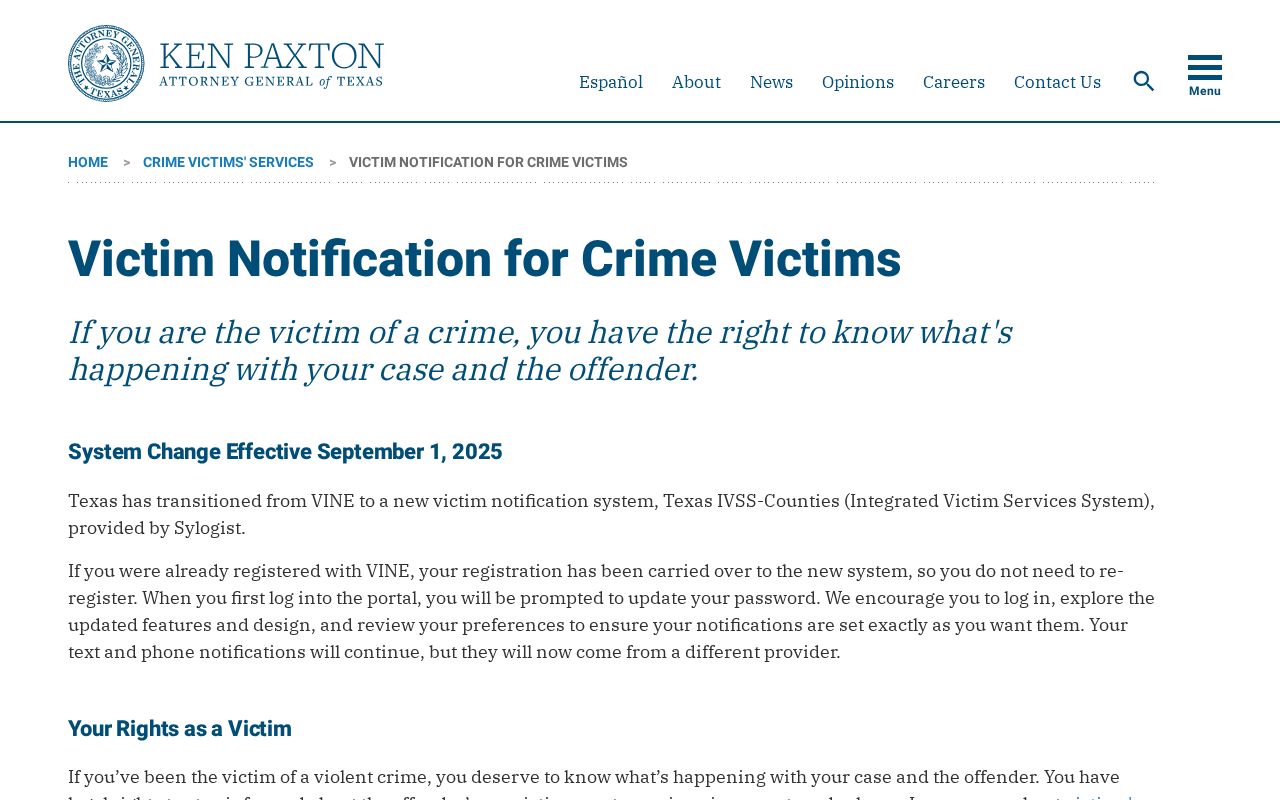
This local mismatch is why the portal URL and date matter. “VINELink” may be the search phrase a visitor knows, but current Texas county instructions should lead to IVSS-Counties.
Retired Texas VINE PIN
The old Texas VINE telephone process used a four-digit personal identification number. A registrant entered that PIN followed by the pound key during an automated alert call. Confirmation stopped repeated calls. Without it, the old system could leave a message and retry.
Those steps are historical. The current IVSS-Counties workflow uses account-managed preferences, contact methods, quiet periods, and notification history. The Attorney General's current page does not instruct a new county user to create the old PIN.
Note: Follow current account prompts, not archived Texas VINE brochure steps.
Refugio Notification Channel Boundaries
Notification systems follow custody ownership. IVSS-Counties is the conditional county path. TDCJ IVSS handles state prison, parole, and mandatory-supervision events for eligible registrants. DHS-VINE serves a separate immigration context, and ICE ODLS can show current immigration custody and some recent ICE releases. The BOP locator serves federal sentenced custody.
| Person's path | Use this channel |
|---|---|
| Refugio County Jail | IVSS-Counties if participating, then sheriff confirmation |
| TDCJ prison or state supervision | TDCJ IVSS and TDCJ offender records |
| Federal sentenced custody | BOP inmate locator |
| Immigration custody | ICE ODLS and DHS-VINE |
| Federal pretrial custody | Federal court and holding facility or USMS |
Choose the system after identifying the destination agency. That one step prevents a county transfer from being mislabeled as final release.
Save Refugio Alert Evidence
When an alert arrives, preserve the agency name, person or case identifiers, event label, event date, and receipt time. Do not expose protected identifiers in a public note. Next, contact the record owner and ask a narrow question about release versus transfer. Notification history shows what was delivered, while the sheriff supplies the durable county custody record.
Two timestamps may differ without either being wrong. The agency event can occur before the notice reaches a phone or email account. A court action can also precede book-out. Report each date for what it represents instead of collapsing them into one release time.
If contact information changes, update the account before relying on an alert. Review preferred hours, blackout dates, paused status, and notification history. These tools replace the older telephone-PIN method.
TDCJ Release Alerts for Refugio
A Refugio resident in TDCJ custody belongs in the state notification channel. TDCJ IVSS can provide eligible registrants with state custody, parole, and discharge notices. The offender search separately exposes location, projected release date, scheduled release information, and parole review details when available.
Those fields differ. A projection is a calculation. A scheduled date may change. Parole eligibility is not approval, and a favorable Board vote is not physical release. Confirm actual release through TDCJ records or the supervising office. Refugio state parole cases map to the Victoria District Parole Office.
TDCJ's victim-notification service and offender search also serve different functions. Notification reports selected events to a registered contact. The offender detail supplies status and date fields when present. A formal information request can provide incarceration history or a release certificate when a durable record is needed. No single alert screen replaces those records, and each result should be saved with its source and check time.
County probation is outside both state-prison release and county custody notification. A person sentenced to local community supervision should be checked through the court record and the Refugio Unit of the 24th Judicial District CSCD. Probation may begin without a TDCJ prison release, so a TDCJ no-result is expected in some local cases.
The same principle applies to full discharge. Parole or mandatory supervision means the person left prison while the sentence continued under conditions. Discharge means the sentence and related supervision ended. Ask the correct office for the exact status rather than reading “not in custody” as proof that all supervision ended.